AI Agents Explained: What They Actually Do in 2026 (And Where They Still Fail)
AI agents finally work — but only for specific jobs. Here is what to use them for, and what to avoid.
"Agentic AI" was the buzzword of 2025. In 2026 it has stopped being a promise and started being a product category. But the gap between marketing demos and what really works in production is still wide.
This is the practical, no-hype guide to AI agents in 2026 — what they reliably do, what they don't, and how to start.
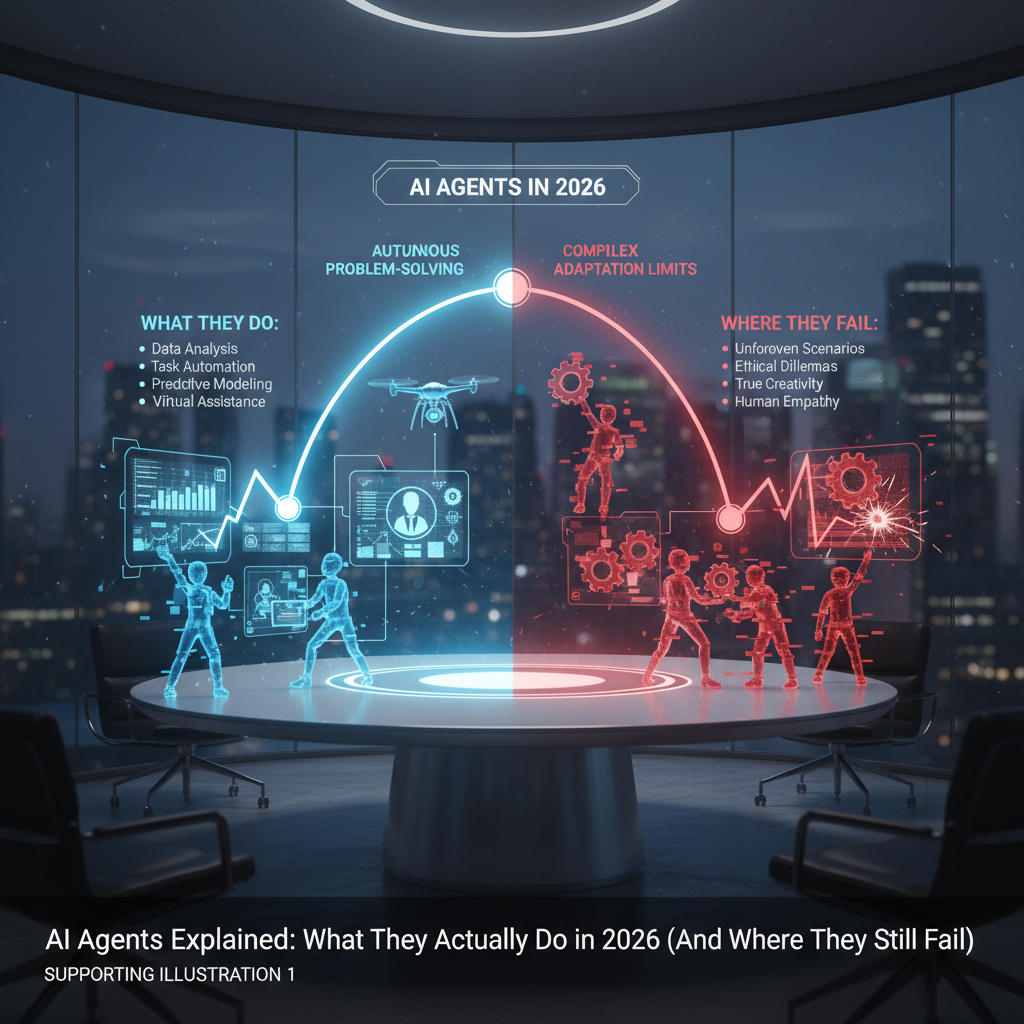
Why AI agents matter right now
Major vendors — OpenAI, Anthropic, Google, Microsoft — all shipped agent platforms in late 2025. By Q1 2026, 38% of enterprises report at least one production agent. The category is real, but it is also narrow: agents work brilliantly in well-defined loops and fail badly outside them.
What AI agents actually are
An AI agent is an LLM wrapped in:
- A goal ("schedule the meeting", "summarize unread email", "triage support tickets")
- Tools (calendar, email, CRM, browser)
- A loop (think → act → observe → repeat)
This is different from a chatbot, which only responds to one message at a time.

Where they shine in 2026
- Inbox triage and reply drafting
- Calendar scheduling across time zones
- Customer support tier-1 ticket resolution
- Recurring research briefs
- Code review and pull-request triage
Where they still fail
- Open-ended creative work (they tend to over-commit to a wrong path)
- Tasks requiring tacit organizational context
- High-stakes financial or legal decisions
- Multi-day planning (memory and consistency are still weak)

Top AI agent platforms in 2026
- OpenAI Agents SDK — most flexible, best multimodal
- Anthropic Claude Agents — safest, best at reasoning
- Microsoft Copilot Studio — best for Office 365 organizations
- Zapier AI Agents — easiest entry point for small teams
For a deeper review of the underlying models, see our GPT-5 vs Claude comparison.
Real-world impact
Companies that deployed agents thoughtfully in 2025 report 20–35% time savings on the targeted workflows. Companies that deployed them poorly report angry customers, runaway API bills, and damaged trust. The difference is scope discipline.

Key Takeaways
- Agents are real, but narrow. Pick one bounded loop per agent.
- Always start with read-only tools before granting write access.
- Build in human review for any irreversible action.
- Track agent cost as carefully as you track headcount.
Frequently Asked Questions
Are AI agents safe to deploy?
Yes, when scoped narrowly with read-only access first and human-in-the-loop on consequential actions.
Will AI agents replace SaaS?
Not yet. Most current agents augment SaaS by working across existing tools rather than replacing them.
How do I start?
Pick one repetitive workflow you understand deeply, document the steps, and prototype with Zapier AI Agents or OpenAI's SDK before going custom.
Conclusion
AI agents finally crossed the line from demo to deployment in 2026 — but only for the teams disciplined enough to use them narrowly. Start small, measure ruthlessly, and expand only when the loop proves itself. For more on automation, see our AI Productivity category.
External references: Anthropic on agentic AI, OpenAI Agents documentation.