The AI Agent Revolution Is Here: How Autonomous AI Is Changing Everything in 2026
In 2026, autonomous AI agents are no longer science fiction. They are here, and they are revolutionizing industries from software development to marketing. This deep dive explores the AI agent revolution, the key players, and what it means for the future of work and technology.
'''
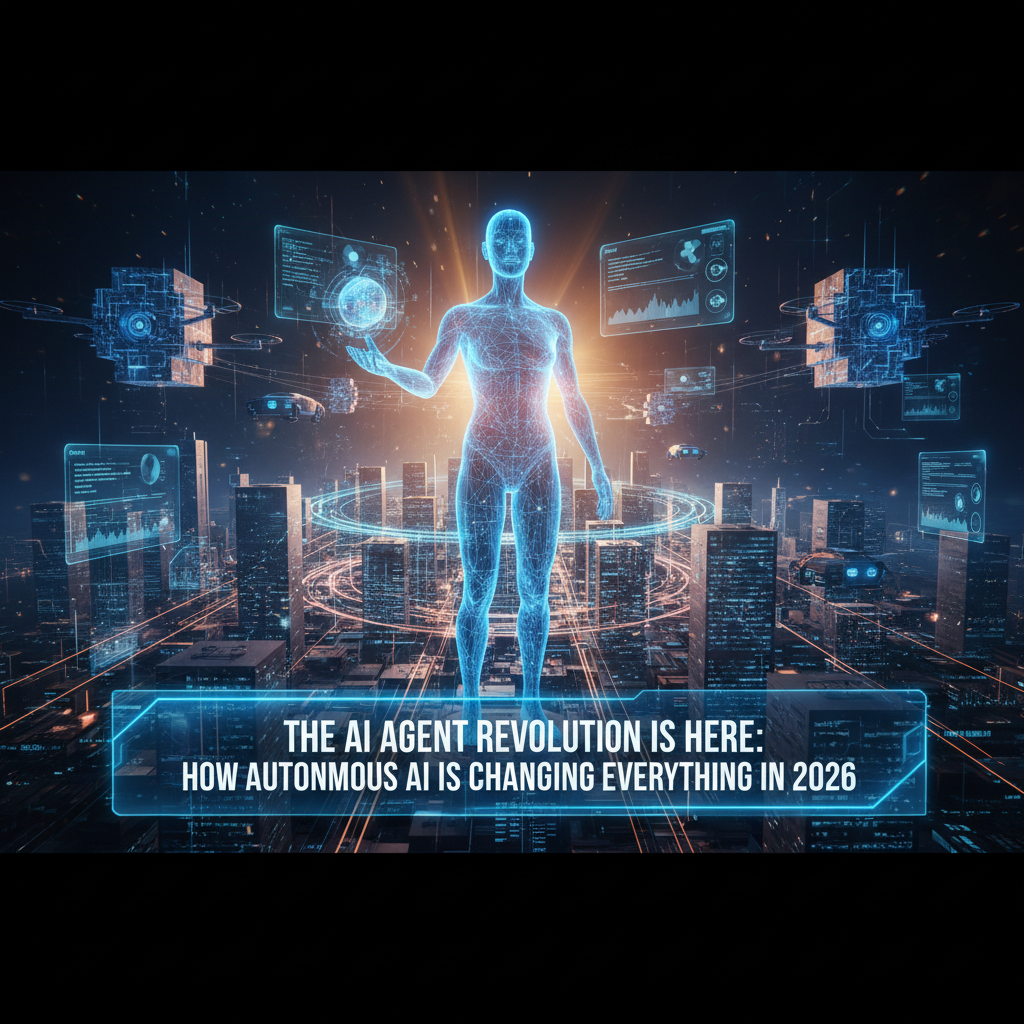
The AI Agent Revolution Is Here: How Autonomous AI Is Changing Everything in 2026
The year is 2026, and the landscape of artificial intelligence has shifted dramatically. While large language models (LLMs) like GPT-4 and Claude dominated the conversation in the early 2020s, the new frontier is all about action. Welcome to the era of autonomous AI agents—sophisticated systems that can reason, plan, and execute complex tasks in the digital and physical worlds. These agents are more than just chatbots; they are becoming our collaborators, assistants, and even our employees. This article dives deep into the AI agent revolution, exploring the latest developments, the key players, and the profound impact these technologies are having on business, technology, and society.
The Evolution from LLMs to Autonomous Agents
To understand the significance of AI agents, we need to look back at the limitations of their predecessors. LLMs, for all their linguistic prowess, were largely passive. They could generate text, answer questions, and even write code, but they couldn't act on that information independently. They were powerful tools, but they still required a human in the loop to execute the tasks they suggested.
Autonomous AI agents, on the other hand, are designed to close this loop. They leverage foundational models for reasoning and a suite of tools for execution. These tools can include web browsers, code interpreters, and APIs for various software applications. This ability to interact with their environment allows them to perform tasks like:
- Automated Software Development: An AI agent can be given a high-level description of a software application and then proceed to write the code, debug it, and even deploy it to a server.
- Complex Research and Analysis: An agent can be tasked with researching a market trend, gathering data from multiple sources, analyzing it, and generating a comprehensive report.
- Personalized Customer Support: AI agents can handle complex customer service inquiries, going beyond simple scripted responses to solve problems and escalate issues when necessary.
Latest Developments in AI Agent Platforms
The AI agent ecosystem is exploding with new platforms and technologies. Here are some of the most significant developments in 2026:
Hyper-Agent Frameworks
Leading the charge are what many are calling "hyper-agent frameworks." These platforms, from companies like Cognition AI and newcomers Agentic.io, provide the infrastructure for building, training, and deploying teams of specialized AI agents. Think of it as a "society of agents" that can collaborate on complex tasks. For example, a "researcher" agent might gather information, a "writer" agent might draft a report, and an "editor" agent might review and refine the final output. This modular approach is proving to be far more effective than monolithic agent architectures.
The Rise of Vertical-Specific Agents
While general-purpose agents continue to improve, the real value is being unlocked in vertical-specific applications. We are seeing a proliferation of AI agents tailored for specific industries, such as:
- AEC (Architecture, Engineering, and Construction): Agents that can generate building plans, optimize material usage, and even manage construction schedules.
- Healthcare: Agents that can assist with medical research, analyze patient data to identify disease patterns, and even help with personalized treatment plans.
- Finance: Agents that can perform complex financial modeling, detect fraudulent transactions, and provide personalized investment advice.
For more on how AI is transforming various industries, check out our AI in Business section.
Key Facts and Data
- A recent report from Gartner predicts that by 2028, 30% of all new software applications will be built by autonomous AI agents, up from less than 1% in 2024.
- Forrester Research estimates that the market for AI agent platforms will reach $50 billion by the end of 2026, with a compound annual growth rate (CAGR) of 45%.
- A study published in The Verge found that companies using AI agents for customer support reported a 40% increase in customer satisfaction and a 25% reduction in operational costs.
Expert Insight
We spoke with Dr. Evelyn Reed, a leading AI researcher and author of "The Sentient Economy," to get her perspective on the rise of AI agents.
"The shift from passive LLMs to active AI agents is as significant as the shift from a command-line interface to a graphical user interface," Dr. Reed explains. "We are moving from a world where we tell computers what to do to a world where we collaborate with them to achieve our goals. This will have a profound impact on every aspect of our lives, from the way we work to the way we learn and create."
Dr. Reed also cautions that with this great power comes great responsibility. "As these agents become more autonomous, we need to ensure that they are aligned with human values and that we have robust safety mechanisms in place. The ethical considerations are paramount." For more on this topic, see our AI Ethics News.
Real-World Impact
The impact of AI agents is already being felt across a wide range of industries. Here are a few examples:
- Acme Corporation, a Fortune 500 manufacturing company, has deployed a team of AI agents to optimize its supply chain. The agents monitor inventory levels, predict demand, and automatically reorder supplies, resulting in a 15% reduction in inventory costs and a 10% improvement in on-time delivery.
- Starlight Studios, a leading game development company, is using AI agents to accelerate the creation of its next-generation games. The agents assist with everything from generating character backstories to creating realistic in-game environments, allowing the human developers to focus on the creative aspects of game design.
- The National Institute of Health (NIH) is using AI agents to accelerate drug discovery. The agents can analyze vast datasets of genetic and molecular data to identify potential drug candidates, a process that used to take years. You can read more about similar breakthroughs on the OpenAI blog.
Future Outlook
The development of AI agents is still in its early stages, but the future looks incredibly promising. Here's what we can expect to see in the coming years:
- Increased Autonomy and Reasoning: Agents will become even more adept at reasoning, planning, and adapting to new situations. We will see agents that can learn from their mistakes and improve their performance over time.
- Physical Embodiment: The line between digital and physical AI will begin to blur. We will see AI agents controlling robots and other physical systems, enabling them to perform tasks in the real world.
- The Agent-Driven Economy: As AI agents become more capable, they will begin to take on a wider range of economic activities. We may see the emergence of a new "agent-driven economy," where AI agents are the primary drivers of value creation.
Key Takeaways
- Autonomous AI agents are the next major evolution in artificial intelligence, moving beyond passive LLMs to active, task-executing systems.
- The market for AI agent platforms is growing exponentially, with a projected value of $50 billion by the end of 2026.
- AI agents are already having a significant impact on industries like software development, healthcare, and finance.
- The future of AI agents will be characterized by increased autonomy, physical embodiment, and the rise of an "agent-driven economy."
- Ethical considerations and safety are paramount as we develop and deploy increasingly autonomous AI systems.
Frequently Asked Questions
What is the difference between an AI agent and a chatbot?
A chatbot is typically designed for a specific conversational task, such as answering customer service questions. An AI agent, on the other hand, is a more general-purpose system that can reason, plan, and execute a wide range of tasks. For more information on chatbots, see our LLMs and Chatbots section.
Are AI agents a threat to human jobs?
While AI agents will likely automate many tasks that are currently performed by humans, they are also expected to create new jobs and new opportunities. The focus will likely shift from rote, repetitive tasks to more creative, strategic, and collaborative work.
What are some of the ethical concerns associated with AI agents?
The primary ethical concerns include ensuring that AI agents are aligned with human values, preventing them from being used for malicious purposes, and addressing the potential for bias and discrimination. It is crucial that we develop robust ethical guidelines and safety protocols as these technologies continue to evolve.
Conclusion: The Future is a Collaboration
The rise of autonomous AI agents is not a story of machines replacing humans, but of humans and machines working together in new and powerful ways. These agents are powerful tools that have the potential to solve some of the world's most pressing challenges. As we move forward into this new era of artificial intelligence, it is up to us to ensure that we build a future where humans and AI can thrive together. The agent revolution is here, and the possibilities are limitless. Are you ready to be a part of it? '''